
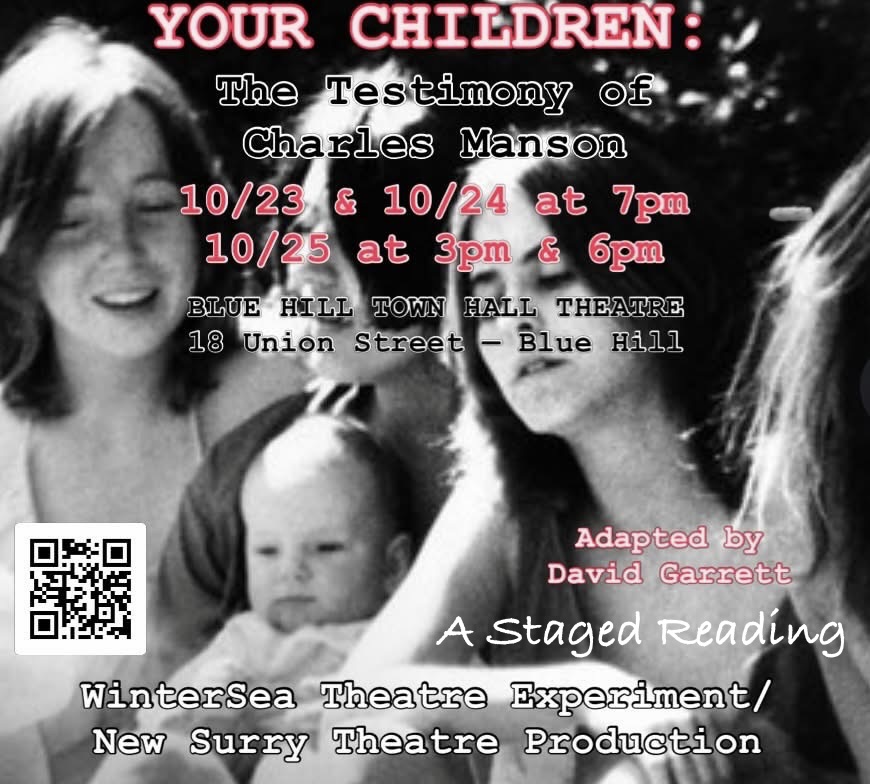
 It was 1992 in Atlanta. I was an aspiring actor, attending Georgia State University. I was by chance and good fortune invited to immerse myself with an ensemble of five new theatre friends from nearby Emory University into the world of Charles Manson. I honestly had not ever heard of him. Born just a few months before the August 1969 Tate-LaBianca killings — for which Manson and his young associates were eventually convicted and sentenced to death — it wasn’t anything that ever entered into my knowing. Until the CHARLES MANSON ON YOUR CHILDREN project my new friend Dave Garrett from Theatre Emory was creating.
We spent what seemed like months immersing ourselves in everything we could find Manson — his 1970 trial testimony, the 1973 Robert Hendrickson Manson documentary, the D.A. Vincent Bugliosi’s Helter Skelter true crime book (and the TV movie based on it) as well as Manson’s 1992 parole hearing and, of course, the Beatles’ White Album. We became a family ourselves, and at the end of our months together, I was changed — both as a theatre artist and as a person. The black hat/white hat reality around me I had always accepted blurred — what was true and real seemed less tangible, the sacred and the profane was not as easy to identify, and it was surprisingly easy to see how with the right causes and conditions, things like what happened in the summer of 1969 could go down. And how I, as well as anyone I might know, could be caught up in it. Especially if a sense of belonging was at stake.
What Charlie said — when I stepped beyond the horror of it all and my preconceived notions— made sense. Revisiting his 1970 trial and 1992 parole hearing testimony years later, it is not a stretch to say his words are prophetic — especially about Nixon, the Vietnam War and our environment. If we can set aside our notions of who Charlie was and what we think he did/didn’t do, focusing on the message rather than the messenger, what we will find is a mirror into ourselves, our society and our own fingerprints of culpability for where we are and where we are heading.
This story we share has no answers to give, only questions to keep asking ourselves with brutal honesty — about who we really are and who we want to be — individually and collectively.
Charlie and those around him exist as a time capsule that is not as removed as we might like to think from what and who we are now. They are but one of many fingers pointing at the Moon, begging us to ask ourselves now, and again now, and again now — “Are you sure?”
Lisa Ann Reilich
Artistic Director
WinterSea Theatre Experiment
*********